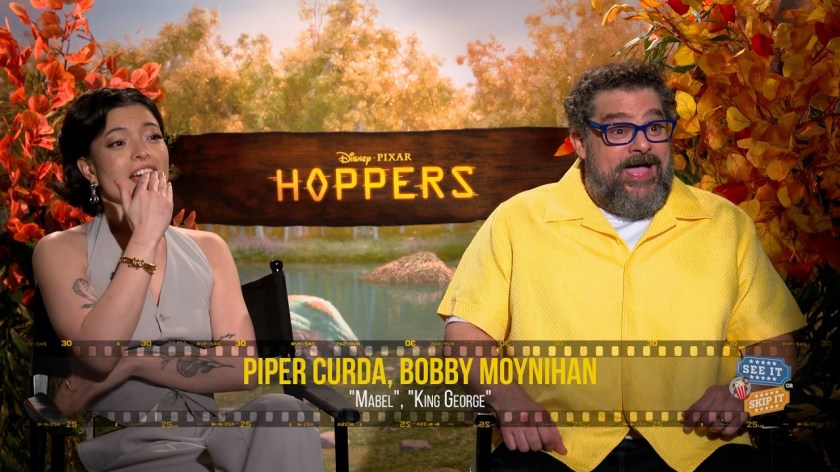
In this exclusive interview, I sit down with Piper Curda and Bobby Moynihan to talk about Pixar’s upcoming animated film “Hoppers.” We dive into what makes this new Pixar story unique, what it was like bringing their characters to life, and why the film’s concept stands out from anything the studio has done before.
But the conversation also takes a turn when I extend a very important invitation to Bobby: becoming the King of Beaver, Utah. His reaction might be the best moment of the whole interview.
“Hoppers” continues Pixar’s tradition of imaginative storytelling, heart, and humor, and Piper and Bobby share what audiences can expect when the film arrives.
Let me know in the comments if you think Bobby Moynihan should accept the royal title.
Patrick B: So glad to talk to both of you. And I don’t know if you realize this, but Utah has a town called–
Piper Curda: Beaver! Yes, I told them that. I drive a lot. And so I live in Chicago. A lot of my family lives here in LA, and it’s for the holidays. I’ll usually drive out and it’s like, you know, it’s only like 30 hours. It’s not too bad, but I’ll stop at little places along the way. And the last time I was driving, I stopped in Beaver, Utah, and I literally was there and I was like, we got to do something here.
Patrick B. This is perfect. Because we don’t have any dignitaries. We don’t have any kings over in Beaver. So I would like to formally extend an offer for a diplomatic trip.
Bobby Moynihan: I accept.
Patrick B: Oh, my gosh, can we get this in writing?
Patrick B: King George has these “Pond Rules”, and they seem simple at first, but there’s a lot of depth to them. But I’m curious, what in your life is your “Pond Rule” that you have?
Nicole Paradis Grindle: One thing I think about a lot is assuming best intentions. I think, again, we’re very polarized right now in the world, and I always want to believe that people are essentially good. It’s one of the things that Mabel says and learns from King George. “Believe that people are essentially good.” Give them a chance. Working on the film, we created these pond rules for our team, where, you know, one of the things we had said was assume best intentions. We tried to minimize hierarchy, trying to make a space where people felt like they could all be filmmakers and join together. We had so much fun. We laughed. We created this environment where people felt safe, and it made the film a better place, and it made our experience better. I hope it’s something that we can all take out into the world.
Patrick B: So fun to see both of you. And see just how well you guys in chemistry are, in person and in the show. What was it like building that? Were you both recording in the booth together? Was it separate?
Bobby Moynihan: I knew a lot about the character of Mabel. In the beginning. I came in a little bit earlier than her, and Daniel explained it so well to me that I felt like I completely understood Mabel. I got it. Then, after meeting Piper, I went, “Now I get it.” Now I get who Mabel is and it kind of solidified everything for me.
Piper Curda: It’s such a weird, weird experience to make an entire movie and not meet any of the other people that are in the movie with you. That’s just not something that’s ever happened to me before. And it’s such a treat to then get to meet them and find out that they’re awful. Just the worst. You have to spend time with them… No. It’s great. I was actually talking to Daniel and Nicole last night. We all had dinner, and then Bobby left early because he’s lame. And has kids and a wife that he loves. This this whole press tour has been really wonderful and really fun, but I’m so scared that if I ever get the chance to do another one, that I’m going to go into it and be like, Bobby’s not going to be there and be like, why is this less fun? Like, why is this kind of boring?
Patrick B. There’s a line, particularly one that I love, that I’m paraphrasing here. “It’s hard to be mad when you realize you’re part of something much bigger.” What does that idea mean to you? And why does it feel like that’s kind of the focal point of this story?
Daniel Chong: That’s a great question. Thank you for asking. I mean, maybe the way I will start answering that question is, you know, we had brought in a bunch of environmental organizers around Mabel’s age, around their 20s, and we asked them, you know, how do you cope with dealing with these big issues that you’re fighting for? Probably not getting a lot of traction. And it’s, you know, these are dark kinds of things that they’re like trying to fight for and deal with. And they said one of the most important things that they had was community people to be around each other. And we realized that having other people connected is an important part of their journey. And then, pushing on to keep fighting. But then we realized, you know, that’s a metaphor for a lot of different things, you know, whether it’s about how we connect with each other as people, how we connect with nature, how we connect with the world around us and the planet, and how beavers kind of bring everyone together and create a community because of their ponds. So it just felt like such a relevant theme to encompass everything in this movie. And I think that’s why we chose to.
Patrick B: Pixar films, they have this enduring quality, especially when you watch it in your younger years. What do you want people who are watching this when it comes out to think about the movie years down the road?
Bobby Moynihan: Wow. That’s the first time we’ve been asked that. And that’s a that’s really a question. I hope that they watch it with their families, and then they watch it with their families again in ten years and talk about how their lives are better because they’re together and because they listen to the rules of the movie.
Piper Curda: Yeah. I mean, I think there is something really beautiful about the relationship that Mabel has with her grandma, and I think that’s something that will always endure. You know, like people have that relationship now, and they’re going to have that relationship in ten years. And so I think that’s something that I hope people can carry with them and see themselves in kind of throughout their lives, and also maybe just for little ones love of animals and nature that, like, carries them through the rest of their lives. That would be so awesome. I mean, “Wall-E” got me thinking about recycling at a young age, so, you know, hopefully this does something kind of similar, but I would love that.
In the end, “Hoppers” looks to continue Pixar’s tradition of combining imagination with meaning, delivering a story that entertains while quietly reminding audiences how much stronger we are when we’re connected to one another. And if Bobby Moynihan ever does take that diplomatic trip to Beaver, Utah, the town might want to start preparing a crown.
 See It or Skip It