
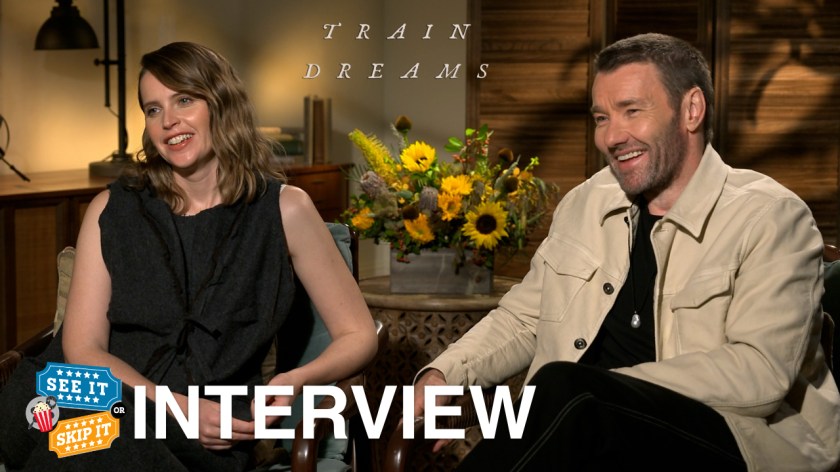
“Train Dreams” is the new Netflix film out this weekend and is a meditation filled with questions about what we chase and what we leave behind. Patrick Beatty spoke with William H. Macy, Kerry Condon, Felicity Jones and Joel Edgerton about love in rough seasons, the grind of early twentieth-century life, and how progress can feel like a blessing and a bruise at the same time.
Patrick B. Your characters both bring a lot of hope into the story. You’re looking to the future. How do we prevent things from happening? My question is for both of your characters. What does the idea mean for progress coming at the cost of something sacred?
William H. Macy: Wow, that’s really good. Well, Arn, certainly. I mean, he’s a rascal, and he’s good at avoiding work and having two suppers. But he’s smart enough to know that there’s a cost. We need the wood faster than the trees can be replaced. He knows that something is being lost, and I love that I got to say that.
Kerry Condon: I suppose I wish we would look to the past to learn. I don’t understand why we don’t learn anything from the past. Especially when you watch this movie and you’re like, “Why have we not wised up? It seems like we’re still the same.” And I suppose progress now to me would be like computers taking over jobs for people and then what, like people are going to commit a crime because they’re not going to have any money. I just wish we would look to the past and learn.
William H. Macy: This movie to me brings up the question of “What does it mean to be human”? Times were tough, back then, they died youn,g and they died violently. It wasn’t a panacea, certainly. But these days, when really we’re not needed, so many of us are just not needed for the fabric of life because there are so many of us. Back then, those guys had to cut trees to supply the wood to make the paper that was needed. If they didn’t do it, somebody else would. One of the things the film does for me is it makes me rejoice in my humanity. It’s not so sad to me. It’s a little melancholy, but hopeful.
Patrick B: You’re dealing with this time where we’re only used to seeing these couples in black and white photos, and we don’t really see them brought to life. You’re in this kind of survival mode where you have to go out and spend so much time away from your wife, but there’s so much tenderness and love when you two are together. What was it like finding that in rehearsal or when it was rolling?
Felicity Jones: It’s quite interesting with improvisation because a lot of it can be really bad before you get to something that works. So you do sometimes feel quite exposed, and you’ll be doing something, and you’re getting this weird feeling that this isn’t working. But hopefully, within those little moments, you find little gems. It felt very straightforward as a filming process. It felt really fluid and easy. Joel had lived with this story for many, many years, and Clint comes with such confidence that he can let you do your own thing, and you can find it together. So it was an incredibly easy experience to make it, actually.
Joel Edgerton: This idea of creating the beating heart of the film that we’re also going to fret for the loss of certain things is building the full picture of a relationship rather than just the kinetic connection. And the love and the intimacy, but also the domestic life and the fear and foolishness of being new parents and the struggles and seeing them in various environments and having tension with each other. It felt like a real, lived-in relationship rather than just this romance. I thought that was one of the successes of building that relationship with Clint.
Felicity Jones: Yeah, you have to be really careful, because sometimes it can go a bit SNL that if you don’t have the authenticity in it, and the authenticity comes from when they’re not getting on with each other, when it’s not perfect, when there’s a feeling of depression. That’s how you find the reality in it
Joel Edgerton: And not the over-beautification of either of us or our romance.
Felicity Jones: Yeah, yeah.
Patrick B: In the film, your characters are seeing these new engines and chainsaws coming in. And I’m wondering, in your careers, in your craft, what was a “chainsaw moment” for you, where maybe something that was really difficult at the start or something in your craft was hard to grab onto. And then as time went on, it became incredibly easy.
Joel Edgerton: Well, for me in a filmmaking sense, it was when Michael Mann and David Fincher were the first couple of guys to go, “we’re going to make a full feature film on digital”. I’m old enough to have shot on film, but the first things I did on film and then I watched film, kind of slip away into the past. Happy to say it’s getting a bit of a resurgence here and there but yeah, it is just overtaking the world in digital. Now I stare at kids doing TikTok videos on the street, and it makes me feel old, disconnected, in the way my grandmother felt when I first pointed a video camera at her and she didn’t understand that she could move.
Felicity Jones: What was amazing is I remember when we were shooting on film that I would always hang around in the trailer. There’d be so much more waiting and then suddenly, when we went digital, there was none. Because you didn’t have to turn around. There was no sort of lengthy lighting. Suddenly, the whole process became so much quicker. But I do have to say, it is lovely seeing stuff going back to shooting on film.
William H. Macy: Those cameras from the Panavision to the Alexa. Steadicams, streaming.
Kerry Condon: Polaroids for continuity. Remember? They take the Polaroid camera.
William H. Macy: A buck a picture!
Kerry Condon: Yeah. And it had them all in a folder because that’s how they do. And now with digital, you can take so many pics. But again, when I started as a teenager, it was still the Polaroid.
William H. Macy: We use no lights on this film. Adolfo shot this whole thing, even the campfire without lights. That means everything goes a lot faster because you don’t have to set up those lights. Those cameras are astounding. They changed everything.
Kerry Condon: Oh, I guess I suppose nowadays, it’s more of an industry, like the awards and stuff, you know? And it’s a good thing, like hair and makeup, and stylists are employed by a lot of people, so it’s become more of a bigger thing. Whereas years ago, even if you look to the 90s, it wasn’t such a big thing. Like people wore their own clothes to stuff. Now it’s a whole industry. But that’s good, a rising tide raises all boats.
Patrick B: If you could bring anything back from the early 20th century to use now that maybe we’ve forgotten as we’ve grown with technology, what would it be?
William H. Macy: Pen and paper. A compass. There’s a great story about the American Navy. Their system went down, and there were 200 ships floating in the ocean, and not one captain knew how to read the stars. They didn’t know how to get home. You can see that the Navy brought them all back and taught them how to read the stars. I think we can get too modern for our own good. AI is going to change everything, man.
Kerry Condon: I don’t know, sometimes I like the barbaric nature of medicine in those days, you know, like they glorified that you can pull out your tooth. Something about that.
William H. Macy: I’ll do without that.
Patrick B: Or what are the things that they would put on to suck the blood? Leeches?
Kerry Condon: Yeah. Oh, yeah! That was wild!
William H. Macy: They still use that, you see, that works.
Kerry Condon: Probably like to lose wage or something?
William H. Macy: No, no, no, you cut off a limb, they’ll put a leech here, and they’ve got something that’ll get the blood flowing. In this modern day and age, they still use leeches.
“Train Dreams” is waiting for you on Netflix. Hit play, ride the rails and come back to See It or Skip It to tell us if this one hit your soul or just passed through your station.
 See It or Skip It