
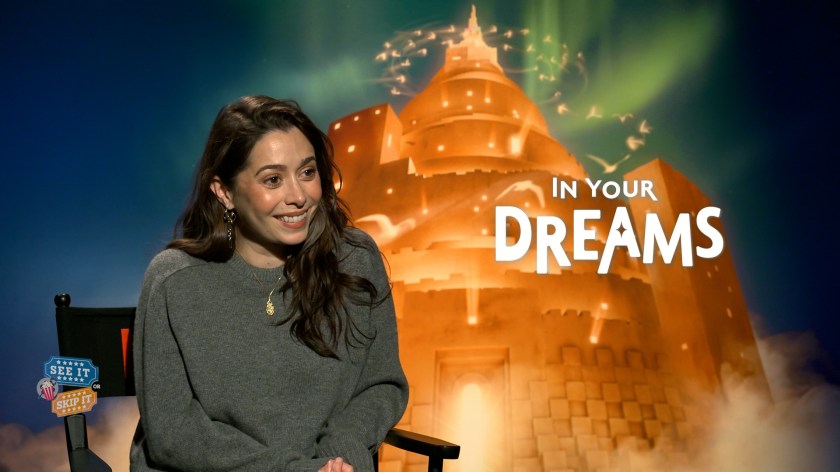
“In Your Dreams,” a heartfelt, family animation, is currently streaming on Netflix, and ABC4 Celebrity Interviewer Patrick Beatty spoke to the stars of the film, Cristin Milioti, Simu Liu, Craig Robinson, Jolie Hoang-Rappaport, and Elias Janssen. Watch and read as the stars open up about the evolving meaning of dreams, family, and the unexpected emotional punch that comes with growing up.
Before we dove into the emotional themes of the film, Cristin Milioti reflected on the musical backbone of the story and the long creative road that led to her favorite day on set.
I’m so excited that they are utilizing your music talent. The song is incredible. I wanted to ask first, what it was like working on it with Simu, and where in the process are you working on it? Was it before you gave your lines for the movie, or was it during?
Cristin Milioti: I actually will have to think about that because it was this was a long process, as they all are. I want to say Alex had told me there was going to be a song in there, and then they wrote different versions of it over the years, and we recorded a bunch of the movie. I have memories of walking around practicing the harmonies, and I think Simu recorded it first, and then I spent a day singing along to it, and it was my favorite day. I love to sing.
Shifting gears to the heart of his character, Simu Liu unpacked why this role hit close to home and how Michael’s internal tug-of-war mirrors the reality so many dreamers face.
What was it about your character when you were reading it on the page that spoke to you, made you want to sign on for this?
Simu Liu: I think it’s that he’s a dreamer. I think every actor can relate to that feeling of not wanting to give up on that dream. Michael or Dad is in that precarious place in his life where he’s being faced with a lot of responsibility, and there’s overwhelming pressure to face reality and to be pragmatic and to do the reasonable thing as a parent and to put the needs of the family first. I don’t think that in any world that any dad sets out to be an absentee or not to do that. I think the question is, in what way do you want to show up as a parent? Because I remember having the exact same thought when I was struggling as an actor of like, well, if I ever start a family, how am I going to how am I going to make ends meet? And am I doing the reasonable thing, continuing to pursue this pipe dream of being an actor? Then there’s the pragmatic element of it, and then there’s the emotional elements of it, right?
think that’s the thing that eats away at Michael, that is, if I give up, what example am I setting for my kids? Life isn’t just about compromise. Life should be about taking risks, and life should be about realizing what your dreams are and giving yourself permission to pursue them, and then doing it. It’s hard for dreamers to face the music in that and to be forced in a way to come to reality, even when I think you could argue it’s the right thing to do in this case.
You two are fantastic together. I think the chemistry between these two kids who still love each other and are going on different journeys in the same way. But Balogne Tony steals so much of this. I love the way the dynamics work with each other, but I need to know, which toy did you own back in the day that, if you were to meet up with them again, would chastise you for forgetting them?
Craig Robinson: Mine is in storage right now.
Jolie Hoang-Rappaport: I don’t know, I think it’s because I forgot that they exist, that they would be mad at me. It’s probably one of the ones that I gave, like, a crazy name when I was a toddler.
Elias Janssen: I had quite a few, and it’d be nice to, like, bring them back because I almost forgot about them. I should go find them.
What do you think the lyrics meant to you as you were going through the process of understanding yourself, your character?
Cristin Milioti: I think what’s really affecting about that song is that there’s a lot of nostalgia and yearning and love in that song, and softness. It’s so moving that that’s what they wrote together when they were really in love, and that they’re revisiting it as they’re struggling. I don’t remember specifically, like if there was one this lyric or the other. Affected me, but I remember I just thought that there’s something special in there, in like the molecules of that song.
Well, it just shows how strong your relationship is. Even though, like you said, they’re going through struggles. I myself am a child of divorce. So there were a lot of things in this that I was relating to, just growing up and thinking about what could be, what couldn’t be right. If there’s anything that you are hoping to have children understand with this, when it comes to your character, what would it be?
Cristin Milioti: What you just said. I think that so many people go through this, and this is also one of the things I was really attracted to about it. I was like, Oh, this affects so many people, and to have any touchstone for that, even if it just helps you think about it differently, if it’s something that has happened to you or something that your family is going through, what a good thing to have in the world.
Patrick B: I love what you said about realizing your dreams because it’s a little interpretive, right? There’s what you want the dream to mean and maybe what you need the dream to mean. What was that like for you in your career? What were some of the dreams where maybe this isn’t necessarily what I’m thinking?
Simu Liu: I grew up with maybe not the strongest sense of self. I think my parents, you know, instilled a very rigid definition of success in me very early on. That’s something that, honestly, a lot of people can probably relate to, and particularly, children of immigrants. Growing up in a foreign environment, there was a lot of focus on academia and on getting good grades and getting a good job. It wasn’t necessarily about figuring out what our dreams were or talking about our dreams. It was like, you get A’s and you get a job, right? I was operating under that notion for like probably most of my life.
Then I turned 22 when I graduated from college, and I got a job, and I showed up to my first day of work, and I was like, oh, shoot, this is what it is? There was this disappointment that came with that, and being in a situation that was particularly fulfilling for me. I didn’t even have the ability or maybe the sense of, you know, the self-awareness to kind of check in with myself all throughout that whole process. It wasn’t until I got fired from that job because I was so bad at it, and because I skipped work to be an extra on a movie set, that I finally had the chance to sit with myself and to say, wait, is this even what I really want? Why am I so broken up about this?
From that point onwards, I was like, well, I might as well do what makes me happy now, because clearly I failed miserably at trying to live out somebody else’s version of success. Once I made that promise to myself, I started to get a whole lot happier. When you live life on on your terms, success or failure, you’re happier.
Dreams can be a great motivation for you to get to a goal that you need, and sometimes it can be kind of a little bit of a fear of what you can or cannot do in your real life. How do you interpret those dreams in your own lives?
This movie did a really good job of showing you that things don’t always work out how you think they should, and that’s like perfectly fine. In that way, dreams are mutable; they’re changeable. You can sometimes hold yourself to a high standard. And we think that, like, if we don’t achieve a particular dream, that’s somehow a failure. That’s what Stevie is going through in the movie. I think that even if your dreams aren’t realized in the way that you hope they are, there’s still so much joy to be found in what ends up happening, especially with the support of your family.
Craig Robinson: Dreams are hard to interpret. They don’t make any sense. I’ve woken up and googled some, sometimes. Oh, what does this mean? But it’s like jump scenes, and then you try to piece it together. It’s weird. Dreams have always been weird to me.
In these animated stories, there’s a lot that kids take away from them, but there’s also a lot of subtext that adults take away. What’s something that the adults are going to take away that maybe the kids don’t see, and vice versa?
Craig Robinson: Adults are probably going to see that you can have problems, and it’s okay to have problems, and it’s okay to work through them. With the kids, you see how a brother and sister could be at odds at all times. But when it comes down to it, you know, their love propels them.
Jolie Hoang-Rappaport: Looking at it like, even just over the course of the movie, like it’s been four years since I started recording this, and even my perspective has changed a lot. I think the more you go through life, the more you look back on an experience like this. The characters are so young, and I feel like there’s a lot of catharsis in seeing their journey and being like, oh, I used to think like that. For kids who are actively going through something like this, the film can be really reassuring that even if things don’t turn out exactly the way you hope, it can still be okay.
Catch “In Your Dreams” now on Netflix, and check out more cast interviews and reviews on “See It or Skip It” for the full breakdown.
 See It or Skip It