
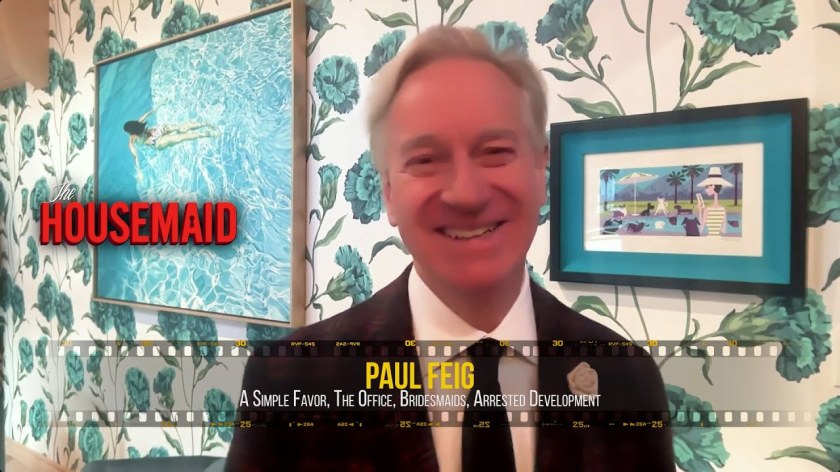
Some movies want you to sit back. “The Housemaid” wants you leaning forward, gripping the armrest, whispering “oh no,” and loving every second of it. That is exactly how director Paul Feig designs his films, not as background noise, but as full-body experiences meant to be shared in a crowded theater. In conversation with Rotten Tomatometer-approved film critic Patrick Beatty, Feig talks about crafting thrillers that invite gasps, laughs, and morally questionable cheering, blending dark subject matter with just enough fun to make audiences squirm in the best way possible.
Paul, it is such a pleasure to meet you. And I’ve loved watching this film in a packed Utah theater, no less. You’re single-handedly bringing sexy back to our state, so I appreciate that.
Paul Feig: My pleasure. I shot a movie there, once. And then I was in a movie that was shot there. So I love Salt Lake. It was a movie called “Unaccompanied Minors” back in 2006, and it was a Christmas movie about kids trapped in an airport. So yeah, we were all over Salt Lake.
I was watching this, and I was with a crowd of people. And I was thinking, you know, we’ve got Avatar coming out last week, and we have these “event films.” But I would argue this is just as much of an event film as the big-budget blockbusters. So, what is Hollywood missing as far as pitching this to audiences? Why do you think it’s an event film?
Paul Feig: Well, thanks, Patrick, I appreciate that. I think it’s an event. I agree with you because, you know, I engineer my movies to be for an audience of people together. I do tons of test screenings when we’re editing the movie to see what works and what doesn’t, and what’s getting a reaction from people. I think an event is something that people interact with, you know? I don’t like audiences to sit there passively, chewing their popcorn and watching the movies. I want them to be leaning forward. I want them to scream and to laugh and to gasp and hide their eyes sometimes, you know? I think it’s really about making movies that a group of people together in a movie theater can have a great time watching.
What do you do when you’re looking at the new fans that maybe don’t know anything about the book, and the people who are looking for very specific things? Do you feel that a film adaptation is more of an interpretation, or are you trying to do it as close to it as you can?
Paul Feig: Well, it’s both, really, because you have source material. It’s one thing if a book is just kind of like something people know, but it’s another thing when a book is on the bestseller list for two years. That’s something people are very passionate about. I want to make sure that they get the experience that they want from the book. But I also want to give them extra. I want to put things in that aren’t in the book, that don’t subvert the book, but add to it. And we were able to add a whole extra ending that’s not in the book, that Frida McFadden, the author, said she thinks the movie is actually better than the book, which is great. But at the same time, you also want people who haven’t read the book to have a full experience. So I always say, because people go, “I have to read the book first.” I’d say, go buy the book, then watch the movie, have all the fun of the twists and turns, and then read the book and see where it came from.
Was there anything in the book that you absolutely had to make sure to get right?
Paul Feig: Yeah. I mean no spoilers, let’s just say it involves a pair of pliers and
What do you think is the trick to making them so approachable to people? For us, being in Utah, if our families came to something like this, they’d be a little squeamish. But it seems to work.
Paul Feig: You really have to bring, even though it’s a very dark story with some very dark themes in it, you have to bring the fun to it. Which sounds weird, but it’s not making fun of the dark things in it. It’s having fun with how people are getting in and out of situations, and how they’re reacting to situations, and how you make the audience lust for payback, and how much they can enjoy the payback. That’s where the fun comes in, while also making sure to treat everything else completely seriously and very close to the bone.
What would you say is taking it too seriously?
Paul Feig: It’s so hard to say without any spoilers. It’s either what we’re making you root for that you shouldn’t root for, so you’re having fun going, “Yeah. That person, you know, something bad happened to that person, they deserved it.” And then you’re later found out like, oh, actually, no, I shouldn’t have rooted for that. That’s fun. And then it’s just also like, you know, the retribution that happens once you realize that character is so terrible that you’re like, okay, I want I want everything bad to happen to that person.
Is this your “Knives Out”? These types of genre-bending thrillers that everybody can have fun with?
Paul Feig: I mean, I love doing them. All I watch is thrillers, so it’s kind of my bread and butter as far as what I enjoy watching. But I jump genres all the time, you know, and, and, there are so many genres I want to play in. I would love to do a musical. I’d love to do a sci-fi epic. I’d love to do a western. I’m kind of case by case, but I definitely would like to make more thrillers because I think they’re fun. As a comedy guy, with a thriller, you get not only the thrills and the audience invested in things, but there are chances to have fun, as Hitchcock did. I mean, if you’re watching “North by Northwest,” it’s as funny as it is suspenseful and scary. A movie, like “Weapons” this year, is very much in that same genre. And Zach Cregger, who did that, is a comedy guy, too. He comes from the comedy world, as I do. So I think we’re just doubling up on our response from the audience. We get the screams and the investment. We also get the laughs after that.
“The Housemaid” is in theaters now, just in time for the Holidays to take your friends and have fun.
 See It or Skip It